I’m often called quiet, reserved, or introverted. As my close friends will tell you, though, there’s nothing I enjoy more than an honest debate. I like trying to understand why people stand by their convictions, their opinions, and their outlook on life. Almost any topic is fair game with me.
Well, with just over fifty days to go until Election Day, we’ve hit the bottom. I’ve been trying to stay up-to-date with the latest political news, but a lot of it just angers me. Every four years it seems the two months that could be most beneficial to America (and possibly the world) are squandered in the face of distortions, chatter, and scandal.
I’ve been trying to come up with an understandable way to express how I feel about the “game” of politics, as Obama put it during a recent event in Virginia. Here’s my view:
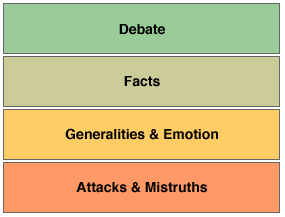
A campaign – or any political discussion, for that matter – can begin at any of these levels and move up and down at will. Let’s look at each level individually.
Attacks & Mistruths: When a person “hates politics,” this is usually what they mean. This level can include out-of-context quotes, innuendo, or outright lies.
Generalities & Emotion: Perhaps the broadest category, this level includes everything from emotional appeals to the use of commonly held beliefs. Often, though, these have little or no backing with actual policies or plans. You’ve heard them all in this election, and they’ve played a key role: hope, change, “country first,” “yes we can,” and so many more. Although the use of these sorts of strategies is better than using attacks and mistruths, they still do not help voters, supporters, or opponents decide rationally.
Facts: Candidates can use facts to support their arguments. Facts can include voting history, personal values, and statistics. Facts must be used with great care, however; misleading statistics fall under mistruths.
Debate: The pinnacle of politics is debate, when two sides come together to discuss their differences in search of the optimal solution to a problem. This is the most inspiring part of politics. Unfortunately, it’s usually the least-used as well.
If debate is the most promising part of politics, why isn’t it used more often? It’s pretty simple; it’s not sexy. Emotional issues of all types create more tension and more fodder for news coverage. When was the last time you saw an outline of opposing views on immigration in a news program or TV ad? (As a side note, this is one reason I enjoyed The West Wing so much as a television show. Though the primary objectives of the show were drama and character development, there was a good amount of discussion and debate about real-life issues in every episode.)
Good, honest debate truly does inspire me. There are many wonderfully intelligent people in the worlds who share different yet perfectly valid views on topics ranging from abortion to gay rights to the environment and climate change. It just doesn’t seem to happen in the months leading up to elections.
What do you think? Did I leave anything out? What advantages are there for a candidate to use less emotional and more rational tactics in a campaign or discussion?